

Quantum Limits, A Tiny Gravitational Wave Detector, & Not-so-missing Mass
This week’s science bits from SWTG
Quantum Computers Might Reveal New Physics

Tim Palmer from the University of Oxford has published a new paper arguing that quantum computers will eventually stop working. His argument is that the entanglement in quantum computers will eventually reach a limit due to Planck scale discreteness – not of spacetime, but of the Hilbert space of quantum mechanics. If so, quantum computers might never succeed in decrypting large codes. I think this specific prediction is very unlikely to be correct, but it seems possible to me that quantum computers will indeed reveal some new physical phenomena. Paper here. Press release here. I talked about this previously here.
Atomic Clouds Could Detect Gravitational Waves
Researchers from Stockholm University have calculated that gravitational waves could subtly alter how atoms emit light. For this, the authors consider a cloud of 10-100 million atoms cooled to near absolute zero. They assume that the atoms are in an “excited” state, meaning they will release energy in the form of photons when slightly disturbed. The authors then calculate that when a gravitational wave passes through the cloud, this very slightly shifts the frequencies of the emitted photons in some directions. While these frequency shifts are tiny (at the level 10-20), the researchers say that the directional distortion might be measurable if one can collect sufficiently many photons.
Gravitational waves are currently detected with kilometre-sized interferometers like LIGO, and shrinking down the equipment would certainly be welcome. The atom cloud gravitational wave detector would measure gravitational waves in the wavelength range of millions of kilometers and up, considerably longer than those measured by LIGO. I am rather skeptical that this will work out any time soon, but it is a good proposal. Press release here. Paper here.
Galaxy Clusters May Hide Their Mass in Dead Stars, Not Dark Matter
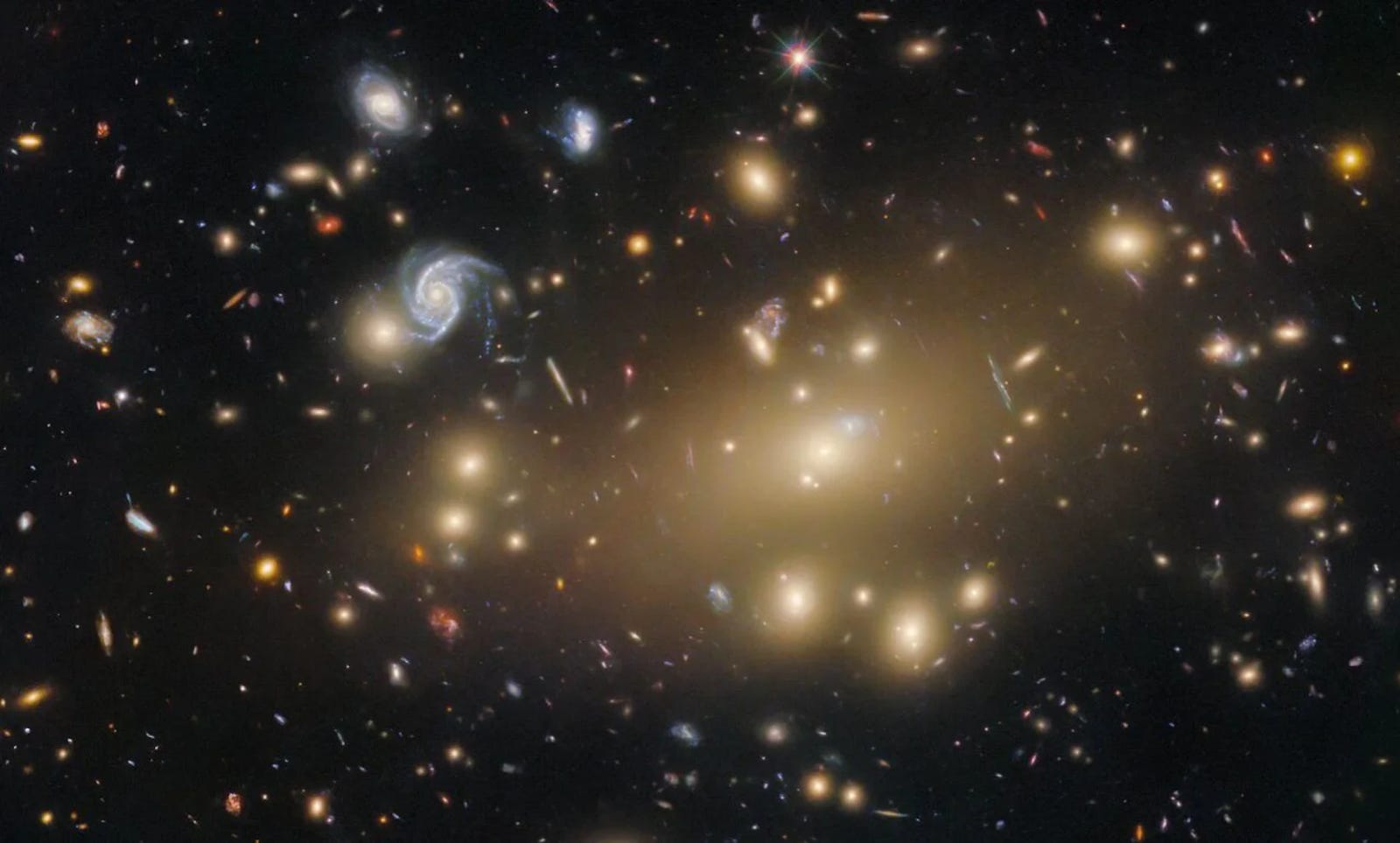
Researchers from the University of Bonn in Germany have re-analysed observations of galaxy clusters and argue that much of the clusters’ “missing” mass may not be exotic dark matter, but ordinary matter in the form of faint stellar remnants. Galaxy clusters have long required about five times more mass than what is visible to explain the observed galaxy motions, an observation that is usually attributed to dark matter. But the authors combined gravitational lensing, X-ray, and optical data with models of star formation – they found that the total mass in stars and their remnants could be almost twice as high as previously estimated.
This matters because Modified Newtonian Dynamics (MOND), an alternative to dark matter, seems to not work well for galaxy clusters. The discrepancy between the MOND predictions and the observations from galaxy clusters almost goes away with the new estimate, while dark matter no longer works all that well. Press release here, paper here.